

Key points:
- Bond yields have been going up since the beginning of the Iran war, widely attributed to inflation expectations due to energy prices
- However, the five-year inflation expectation priced into Treasury Inflation-Protected Securities is 2.2% and trending down since May
- The driver appears to be rising real yields with bearish implications for yield-free assets like Bitcoin
Continuation of Q2 bond selling
After yields reached local lows in early March, US government debt has been undergoing a multi-month sell-off. This week, after the most recent meeting of the Federal Open Market Committee (FOMC), 30-year Treasury yields made headlines by reaching the highest level since 2007.
In line with the two-year yield rising 76 basis points (bps) in this window, a September rate hike by the Federal Reserve is priced into the markets at 63%, according to CME FedWatch.
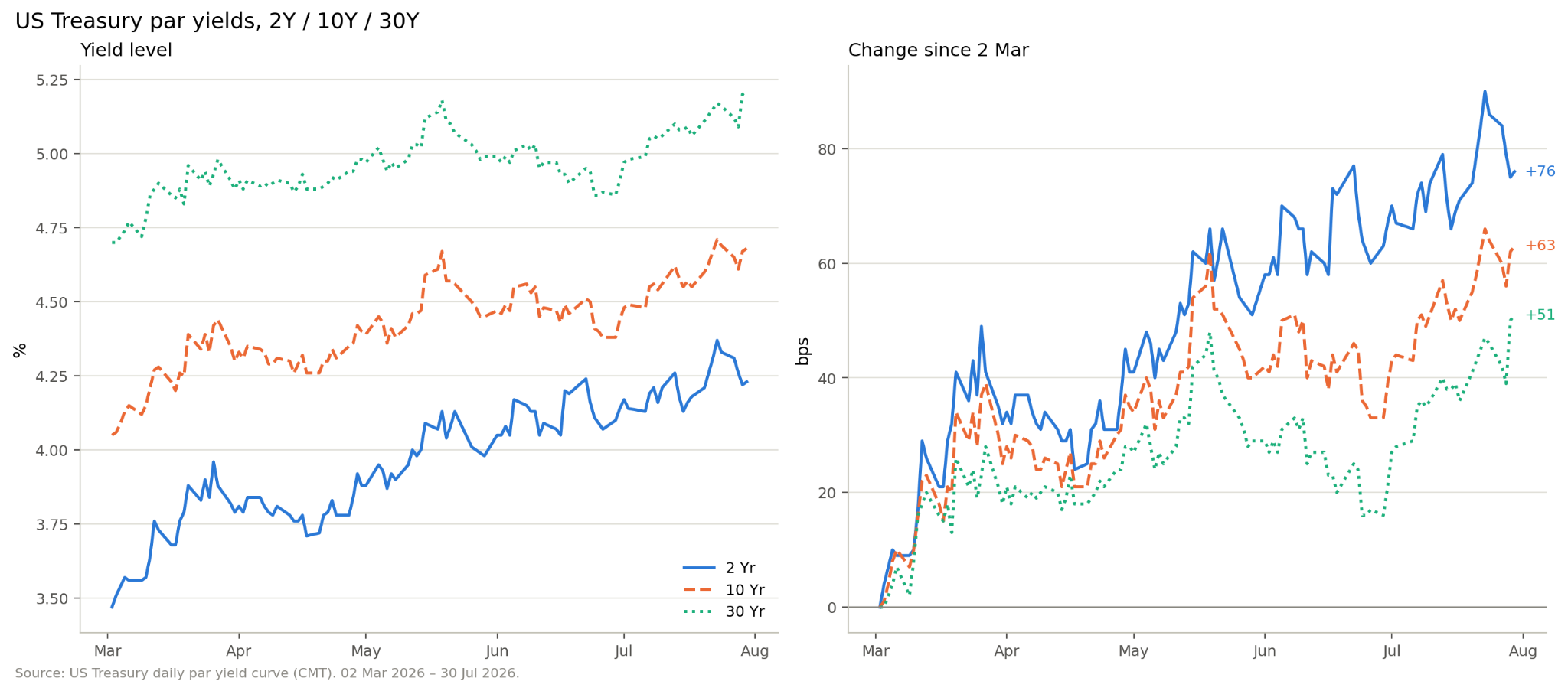
2Y, 10Y and 30Y US Treasury Yields. Data Source: Treasury.gov
With rates at these elevated levels, government bond investments are, for the first time since 2019, more profitable than cash-and-carry trades in the crypto markets, as per Glassnode’s latest research.
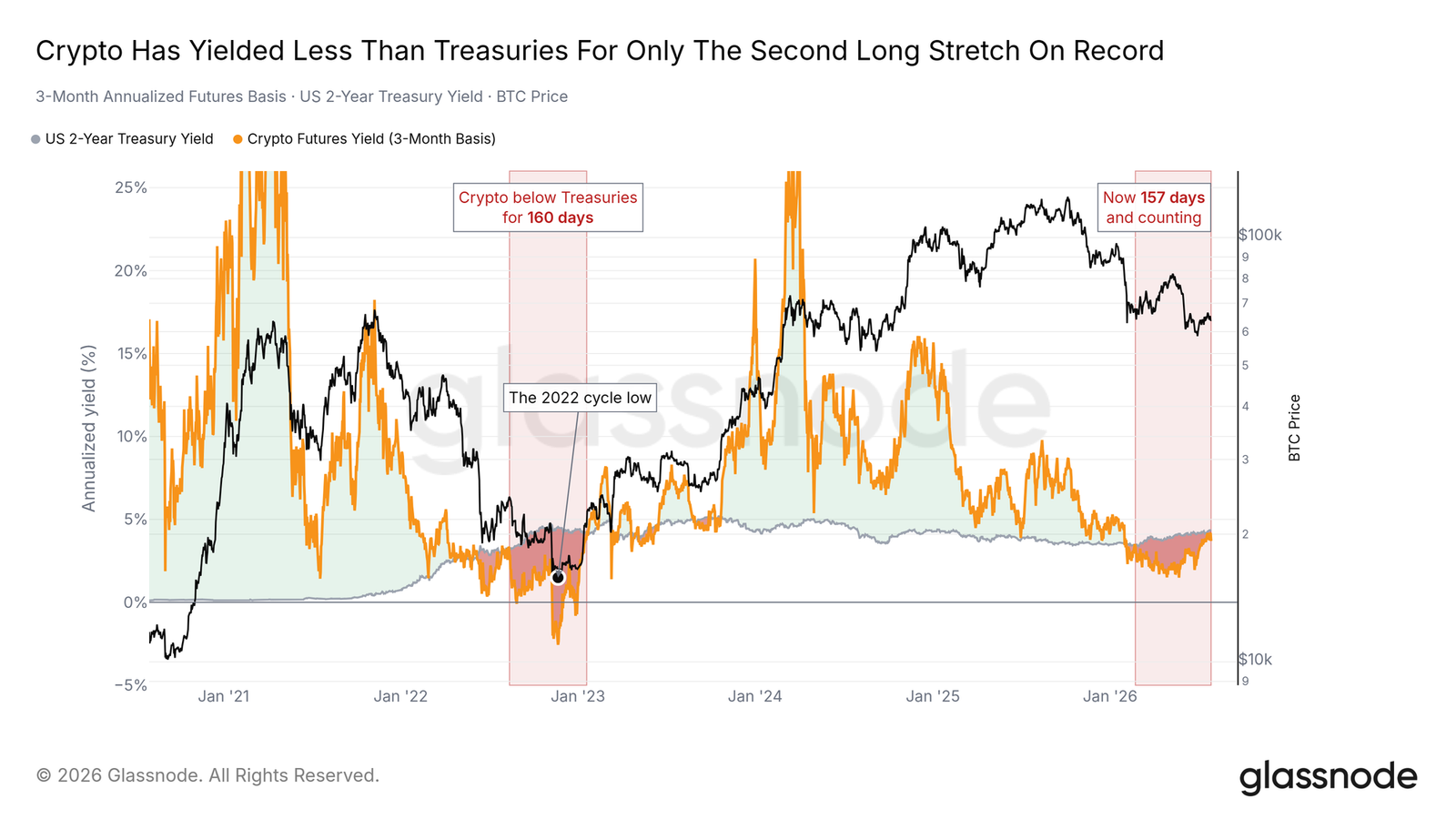
2Y US Treasury yield and crypto futures carry trade. Source: Glassnode
The mainstream inflation narrative
The reason for the bond sell-off is commonly taken to be the inflationary pressures from higher commodity and energy prices. The multi-month bond sell-off coincides with the start of the Iran war and resulting closure of the Strait of Hormuz. Furthermore, the daily closes of the two-year US government bond yield, West Texas Intermediate (WTI) and Brent Crude have correlated since March at a coefficient of r=0.44:
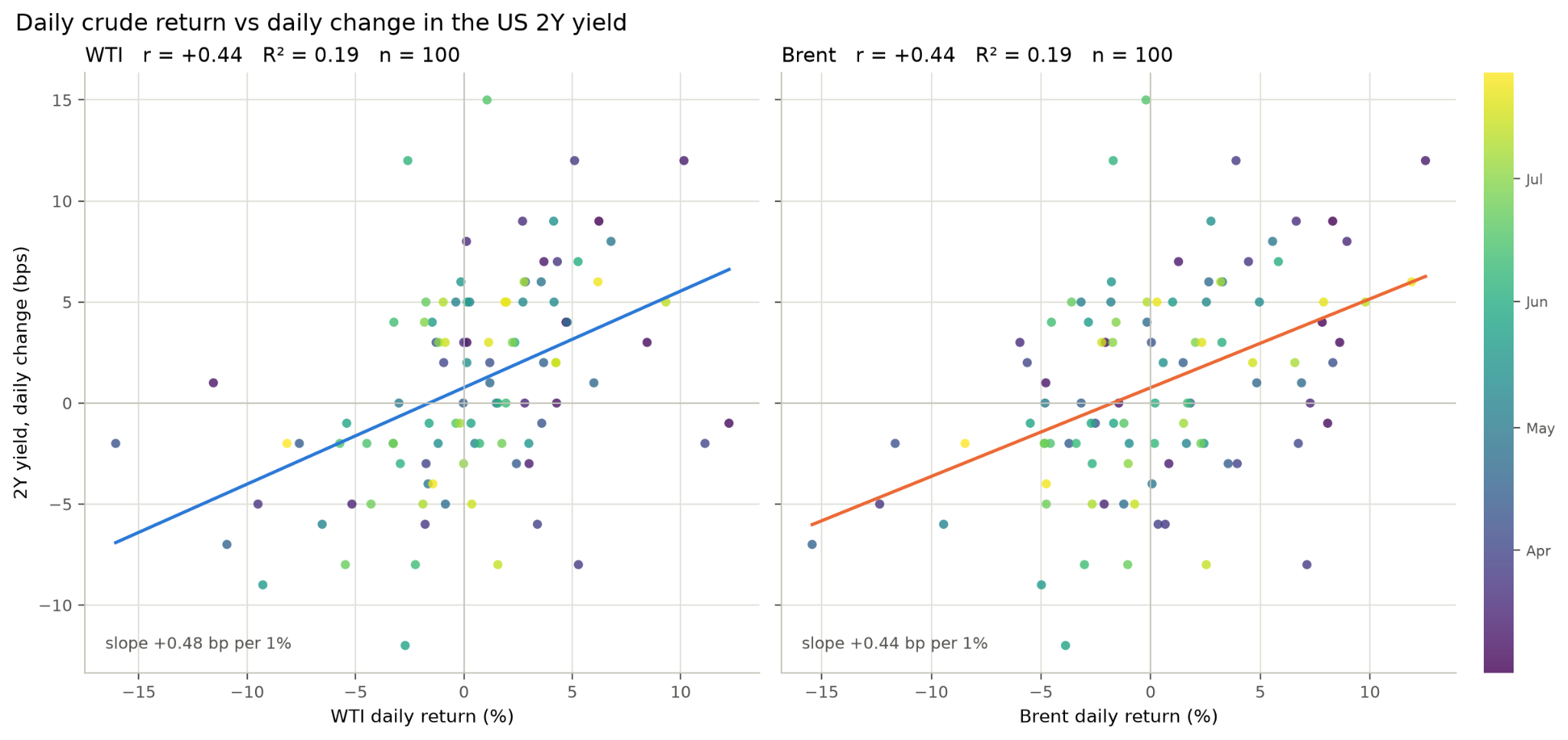
Daily closes of WTI and Brent Crude against 2Y Yield. Data Sources: fred.stlouisfed.org, EIA
WTI briefly rose once again above $85 a barrel on Thursday after President Donald Trump threatened Iran and bonds sold off leading into the FOMC. Nothing about the conflict suggests a near-term resolution, which has led some to argue that higher rates are being caused by inflation expectations.
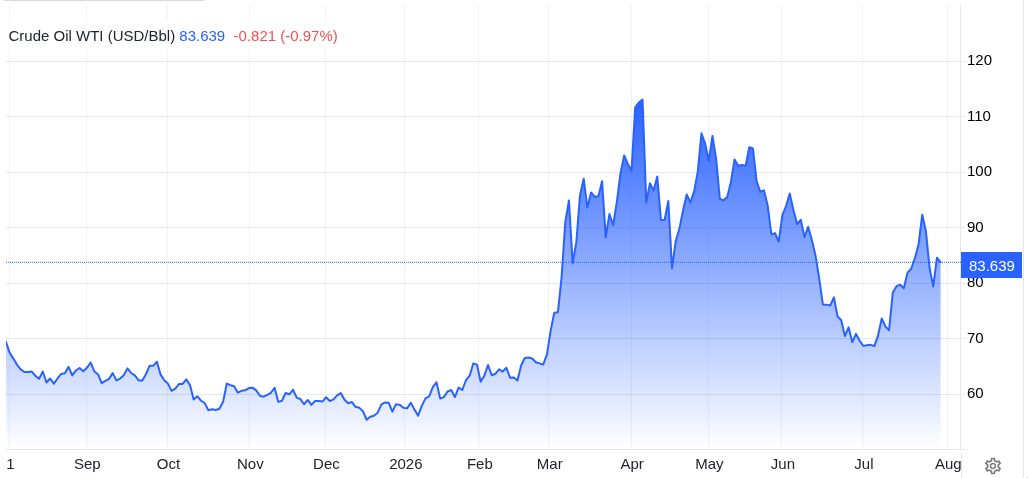
WTI (West Texas Intermediate) oil price chart. Source: Tradingeconomics.com
This has driven loud inflation scares through the mainstream financial press, with recent Bloomberg headlines, such as “Global Bonds Are Reeling as Oil Surge Rekindles Inflation Threat”, “US Yields Hit Two-Month High as Oil Sparks Inflation Risk” or “Global Bond Selloff Worsens as Rising Oil Prices Spook Investors”. Among the ever-inflation-aware crypto and precious metals audience, this narrative is popular, too:
Market commentator and Bitcoin influencer The Wolf of All Streets recently posted on X:
However, the way other Treasury securities trade does not support the inflation-driven narrative for bond yields.
TIPS say rate rises are ‘real’
While most analysts and commentators focus on regular Treasury yields for their analysis, Treasury Inflation-Protected Securities, or TIPS, have offered clear signs against the inflation narrative.
A Treasury Inflation-Protected Security (TIPS) is an ordinary treasury bond for which the principal payment is adjusted upward in line with the Consumer Price Index for All Urban Consumers (CPI-U). In addition to the inflation-protected principal, each TIPS carries a fixed coupon rate. Thus, unlike for a regular bond, both principal and interest payments are inflation-adjusted.
By comparing the yield of a TIPS with a regular, equally dated Treasury, the expectation of future CPI inflation can be estimated as the so-called breakeven rate. And although Treasury yields have been rising, the five-year breakeven rate has gone down sharply since May.
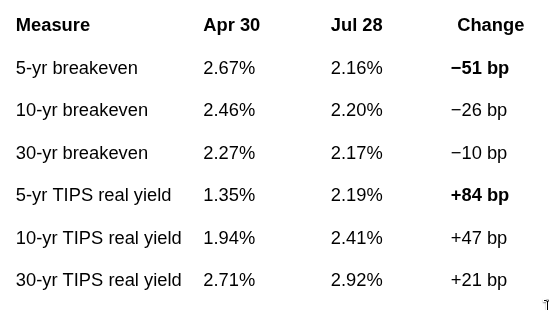
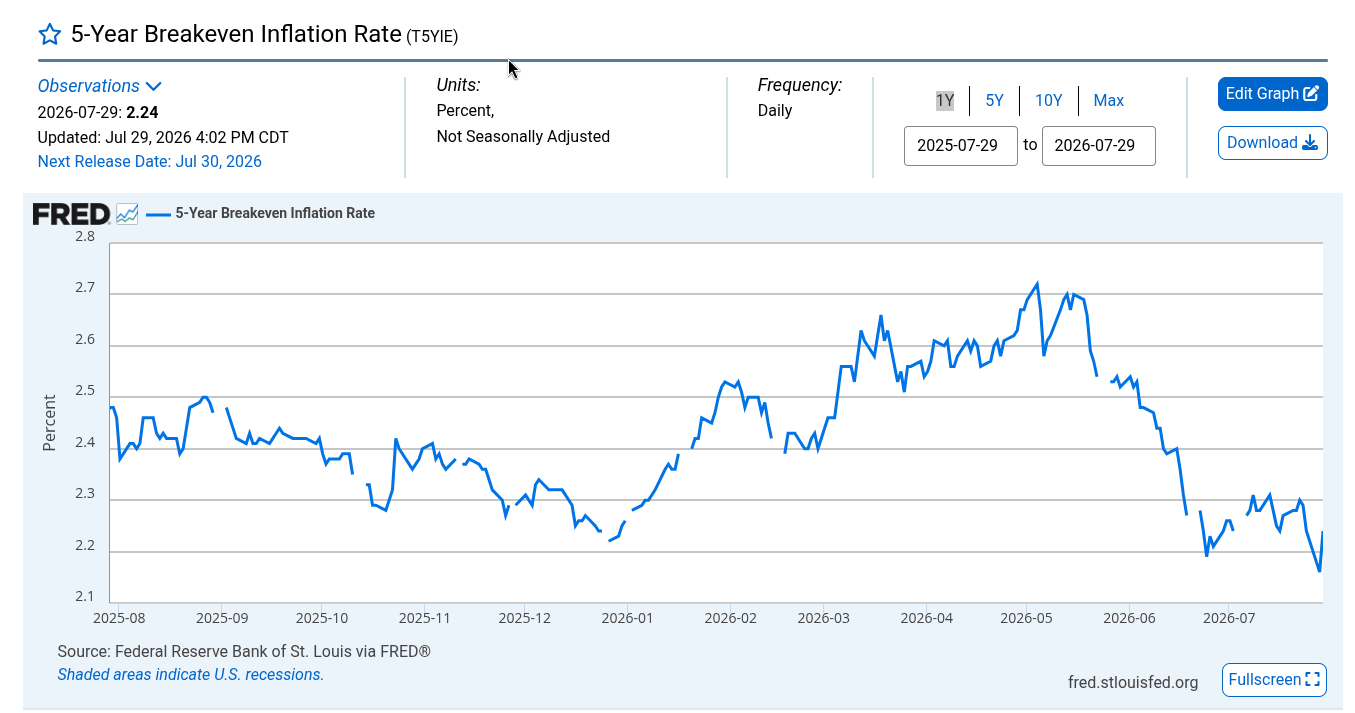
Five-year breakeven inflation rate. Source: fred.stlouisfed.org
At roughly 2.2%, the five-year breakeven expects the Fed to achieve its 2% target in the medium term. However, more telling is that the breakeven rate has been moving in the opposite direction to the nominal treasury yields.
While the five-year nominal yield rose 33 bps, TIPS data suggests this was the result of an 84 bps rise in the real yield, partially offset by a 51 bps decline in expected inflation. While the inflation narrative remains a compelling story, the marketplace says otherwise. The real story ought to be a rise in real yields.
What it may mean for crypto
Generally, rising “real” investment returns on bonds and stocks in terms of CPI make non-yielding assets such as Bitcoin relatively less attractive to certain investors. Beyond this, the impact on the crypto market depends on the explanation for higher real rates, of which several are available.
Reserve liquidation — No clear impact on Crypto. Higher oil prices widen trade deficits for Asian energy importers. As oil is generally priced and settled in US dollars, shortages in the local eurodollar markets in Asia have occurred, which has put their exchange rates under pressure. The Japanese yen (JPY), Philippine peso (PHP) and Indian rupee (RBI) have all required central bank intervention to defend their exchange rates. As these measures are funded by the sale of US Treasury reserves, this puts upward pressure on bond yields. HSBC’s Frederic Neumann is on record attributing the bond sell-off to FX pressure rather than a verdict on the dollar.
Demand destruction — Bearish for Crypto. An oil shock that persists long enough stops being inflationary and starts triggering a recession. Neuberger Berman argued in its second-quarter outlook that investors are underpricing the hit to output from sustained energy prices. The credit contraction that coincides with a recession would be bad for equities and Bitcoin by severely restricting liquidity. In a real sign of recessionary credit events, credit spreads are expected to widen. Cointelegraph reported on possible first signs of this on Wednesday.
Related: Cost to insure AI debt reaches record high amid Asian semiconductor tumble
Investment demand — Likely bearish for Crypto. Real rates may have also responded to expected growth and the demand for capital from the AI sector. Government bond issuance is increasingly competing with the record issuance of corporate bonds from AI hyperscalers. Goldman Sachs Research projects roughly $755 billion of AI capex in 2026 and about $920 billion in 2027. UBS has raised its 2026 investment-grade issuance forecast to $1.8 trillion, with technology supply lifted to $360 billion on hyperscaler guidance. As crypto is competing for a similar pool of capital and investor cohort, this is likely to suppress the sector.
Source: cointelegraph.com